


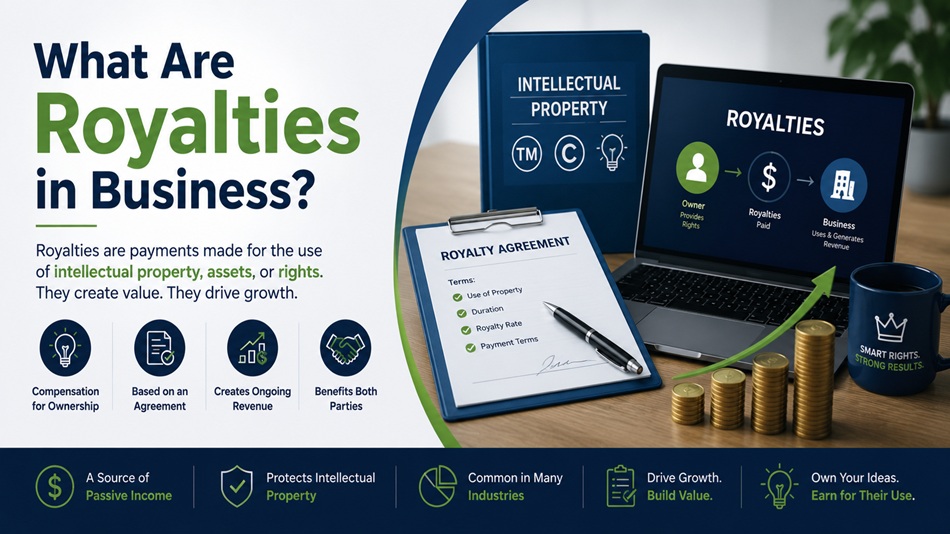
Royalties are one of those business concepts that most people encounter regularly without fully understanding the mechanics behind them. A musician receives a check every time a song plays on streaming services. A novelist earns a percentage of every book sold. A technology company licenses its patented process to a manufacturer and collects a fee on every unit produced. A franchisee pays the franchisor a percentage of monthly revenue. All of these are royalties, and they operate on the same fundamental principle even though the industries and assets involved are entirely different.
Understanding how royalties work matters whether you’re on the receiving end as a creator or intellectual property owner, on the paying end as a licensee or franchisee, or simply trying to understand how a business model generates its revenue.
The Core Definition
A royalty is a payment made by one party to another in exchange for the right to use an asset, intellectual property, or resource that the payer doesn’t own. The payment is typically calculated as a percentage of revenue generated through the use of that asset, though flat-fee and per-unit structures are also common.
The party receiving the royalty is the licensor, the owner of the asset being used. The party paying the royalty is the licensee, the party using it. The legal arrangement governing the relationship is a licensing agreement, which defines the scope of permitted use, the royalty rate, the payment schedule, the term of the arrangement, and the conditions under which it can be terminated.
The key distinction between a royalty and a simple purchase is that a royalty grants rights to use an asset without transferring ownership of it. The licensor retains ownership and can license the same asset to multiple parties simultaneously or reclaim it when the agreement expires.
The Main Categories of Business Royalties
Royalties appear across several distinct categories, each with its own industry conventions, typical rate ranges, and legal frameworks.
Intellectual Property Royalties
Patents, trademarks, and trade secrets generate royalty income when their owners license them to other businesses for commercial use. A pharmaceutical company that holds a patent on a drug compound licenses that patent to manufacturers who pay a royalty on every unit produced or sold. A technology company that has patented a manufacturing process licenses it to production facilities that incorporate the process into their operations.
Patent royalty rates vary enormously by industry and the commercial value of the specific patent. Pharmaceutical patent royalties often run between 2 and 10 percent of net sales, reflecting both the high value of patented drug compounds and the extensive negotiation that accompanies major licensing deals. Technology patent royalties typically run between 1 and 5 percent of relevant revenue, though standard essential patents that are required for compliance with industry standards are licensed under FRAND terms at rates that reflect their foundational nature.
Trademark royalties arise when a brand owner licenses the right to use its name, logo, or brand identity to another business. Franchise royalties, discussed separately below, are a specific form of trademark royalty combined with the right to use a complete business system.
Music and Entertainment Royalties
The music industry generates royalties across multiple parallel streams that flow to different rights holders for different types of use. Mechanical royalties are paid by streaming services and record labels to songwriters and publishers for the reproduction of a composition. Performance royalties are paid by radio stations, streaming services, and venues for public performance of a song. Synchronization royalties are paid by filmmakers, advertisers, and video game producers who use music in their productions.
These royalties are administered through performance rights organizations including ASCAP, BMI, and SESAC in the United States, which collect royalties from music users and distribute them to member songwriters and publishers. The complexity of music royalty accounting reflects the number of distinct rights that exist in a single song and the multiple revenue streams that each generates simultaneously.
Book publishing royalties are paid by publishers to authors based on copies sold, typically ranging from 10 to 15 percent of retail price for hardcover editions and 6 to 8 percent for paperbacks in traditional publishing arrangements. Self-publishing platforms including Amazon Kindle Direct Publishing offer royalty rates of 35 to 70 percent of the sale price, the higher rate applying within Amazon’s defined price range requirements.
Franchise Royalties
Franchise royalties are the ongoing fees paid by franchisees to the franchisor in exchange for the right to operate under the franchise brand and system. They’re typically calculated as a percentage of gross revenue, running between 4 and 12 percent across the franchise industry, with additional marketing fund contributions of 1 to 4 percent on top of the base royalty.
The franchise royalty is distinct from the initial franchise fee, which is a one-time upfront payment for the right to enter the franchise system. The royalty is the ongoing cost of operating within the system, paid throughout the term of the franchise agreement regardless of profitability. This structure means that a franchisee who is barely breaking even continues paying royalties on revenue that isn’t generating profit, which is one of the more challenging aspects of franchise economics in difficult periods.
Natural Resource Royalties
Mineral rights owners receive royalties from oil, gas, and mining companies that extract resources from their land. Oil and gas royalties in the United States typically run between 12.5 and 25 percent of production value, varying by state, lease terms, and negotiated arrangements. Landowners with mineral rights receive these payments whether or not they participate in the extraction operations, making mineral royalties one of the few genuinely passive income streams available to private individuals.
Federal and state governments collect royalties on resource extraction from public lands, representing a significant revenue stream from the commercial use of publicly owned natural resources.
Software and Technology Royalties
Software licensing royalties arise when technology companies license their software, algorithms, or technical processes to other businesses for incorporation into their products or services. Open source software changes this dynamic considerably, with many open source licenses permitting use without royalty payments subject to specific terms around attribution and derivative works.
Platform royalties have become a significant category as app stores and digital distribution platforms charge developers a percentage of revenue generated through their platforms. Apple’s App Store and Google Play both charge 30 percent of app purchase revenue and in-app purchases, reduced to 15 percent for smaller developers and subscription renewals in Apple’s case. These platform fees function economically as royalties on the right to access the platform’s distribution network and customer base.
How Royalty Rates Are Determined
Royalty rates aren’t established by formula. They’re negotiated based on several factors that vary by industry, asset, and the respective bargaining positions of the licensor and licensee.
The commercial value of the asset being licensed is the primary driver. An asset that is essential to the licensee’s business or product and has no readily available substitute commands higher royalty rates than one that is useful but replaceable. A patent that covers the only viable manufacturing process for a critical component sits in a different negotiating position than a trademark that adds brand recognition value but isn’t essential to the product’s function.
The 25 percent rule is a traditional starting point for intellectual property royalty negotiations that suggests the licensor should receive approximately 25 percent of the operating profit generated by the licensee through use of the licensed property. This rule is a negotiating heuristic rather than a legal standard, and actual rates vary significantly above and below it depending on industry conventions and specific circumstances.
Comparable license agreements for similar assets in similar industries provide benchmarks that inform negotiations. Courts evaluating patent infringement damages have developed extensive case law on reasonable royalty rates that creates a body of reference data for licensing negotiations in contested situations.
The term of the license affects the rate. Longer license terms that provide the licensor with extended income certainty may justify lower per-period rates than shorter terms where the licensor faces renegotiation risk.
Royalty Accounting and Reporting
Royalty accounting creates specific obligations for both licensors and licensees that require accurate tracking and transparent reporting.
Licensees must track the revenue or units subject to royalty calculation accurately and report that information to licensors on the schedule defined in the licensing agreement, typically quarterly or annually. Underpayment of royalties, whether through inaccurate reporting or deliberate understatement, is a breach of the license agreement and can trigger audit rights and termination provisions.
Licensors receiving royalties need to account for them as revenue in the period earned, which may differ from the period received depending on the accounting method used. For licensors whose primary business is licensing intellectual property, royalty revenue accounting follows revenue recognition standards that require careful attention to the timing and conditions of recognition.
Audit rights are standard provisions in licensing agreements that allow licensors to examine the licensee’s relevant financial records to verify the accuracy of royalty reports. Exercising audit rights is a normal business practice in active licensing relationships rather than an accusation of wrongdoing, and significant underreporting discovered through audit typically triggers a catch-up payment plus interest and sometimes penalties.
Tax Treatment of Royalties
Royalties are generally treated as ordinary income for tax purposes, subject to income tax at the recipient’s applicable rate. For individual creators and intellectual property owners, royalties are reported as self-employment income subject to self-employment tax as well as income tax if the royalty activity constitutes a trade or business.
Tax treaties between countries affect the withholding tax treatment of royalties paid across international borders. Many bilateral tax treaties reduce or eliminate withholding taxes on royalty payments between treaty countries, which is a significant consideration for businesses with international licensing arrangements.
The qualified business income deduction may be available to individual royalty recipients who operate their licensing activity as a pass-through business, potentially allowing deduction of up to 20 percent of qualified royalty income from taxable income subject to the limitations and thresholds that apply to that deduction.
For a comprehensive and authoritative treatment of the tax rules governing royalty income across different contexts including intellectual property royalties, natural resource royalties, and international arrangements, the IRS Publication 525, Taxable and Nontaxable Income provides the most reliable guidance on how royalties are treated for federal tax purposes across the range of situations in which they arise.
Building a Royalty-Based Business Model
For businesses built around intellectual property creation or licensing, the royalty model offers specific advantages that other revenue structures don’t provide.
Scalability without proportional cost increase is the primary structural advantage. Once an intellectual property asset is created and licensed, additional licenses generate revenue without requiring proportional additional investment. A software company that licenses its platform to a hundredth customer doesn’t incur hundred times the cost of licensing to the first customer. A songwriter whose music is licensed for use in a major film generates a synchronization royalty without producing any additional creative work.
Portfolio diversification of royalty income across multiple licensees and geographic markets reduces dependence on any single revenue relationship. A patent portfolio generating royalties from twenty licensees across multiple industries is far more resilient than a licensing arrangement with a single exclusive licensee.
The ongoing nature of royalty income from successful assets creates revenue predictability that project-based or transactional revenue models don’t provide. Established intellectual property with multiple active licensees generates income that can be projected with reasonable confidence and, in some cases, capitalized and sold as an income stream.
The practical challenge of building a royalty-based business model is the upfront investment required to create intellectual property valuable enough to license at commercially meaningful rates, and the legal and administrative infrastructure required to manage licensing relationships at scale. Businesses that have created valuable intellectual property and built systematic licensing capabilities are among the most capital-efficient businesses that exist. Getting to that point requires sustained creative and operational investment that most royalty-based businesses underestimate at the outset.